
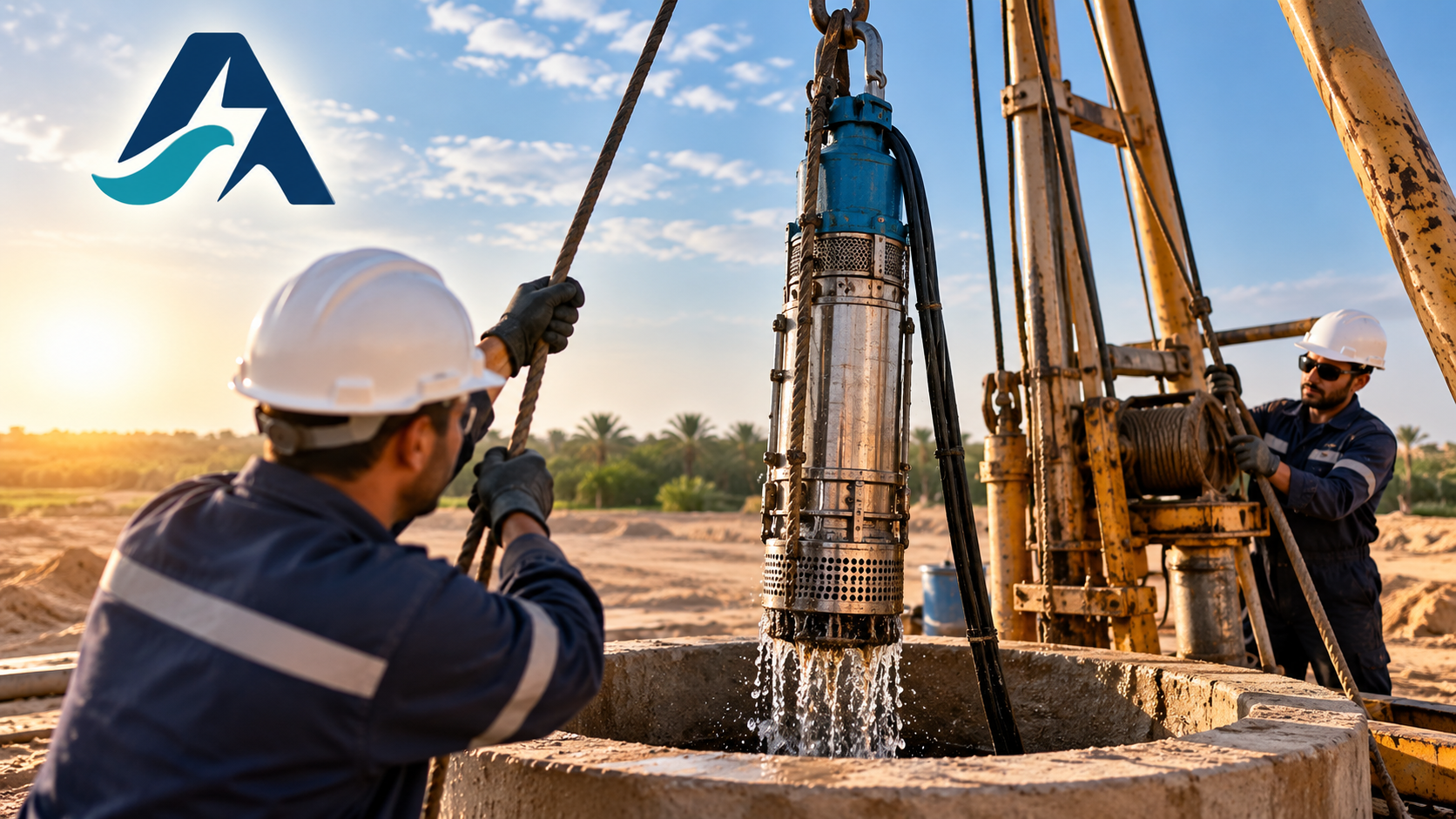
# Fishing and Recovery of Fallen Submersible Pumps
A Fallen Pump Is Not the Only Problem — The Real Question Is Why It Fell
When a submersible pump falls inside a well, the first question most well owners ask is:
“How can we get it out?”
At **Aqua Voltx**, we start with a more important question:
**“Why did it fall in the first place?”**
Because recovering the pump without identifying the actual cause of the failure may result in the same problem happening again, leading to additional maintenance costs, repair expenses, and potentially more serious damage inside the well.
That is why Aqua Voltx follows a clear approach:
**Diagnose first. Recover second.**
What Does It Mean When a Pump Falls Inside a Well?
A fallen pump occurs when the submersible pump, or part of the pumping assembly, becomes disconnected from the riser pipes, couplings, or supporting components during operation, maintenance, installation, or removal.
The pump may then settle tens or even hundreds of meters below ground level, depending on the depth of the well.
Recovering a fallen pump requires:
- Specialized fishing and recovery equipment.
- Technical experience in well operations.
- Accurate identification of the pump location.
- Selection of the correct fishing tool.
- Careful execution to protect the integrity of the well.
Improper or random recovery attempts may damage the pipes, electrical cables, casing, or other components inside the well, making the recovery process even more difficult.
# What Are the Main Causes of Pump Failure and Falling?
1. Corrosion of Pipes and Connections Due to Water Salinity
Many older wells were constructed using steel or other metallic pipes and fittings.
When groundwater contains high levels of salinity or corrosive elements, metal pipes, bolts, couplings, and fittings may gradually deteriorate over time.
Eventually, these components may lose their ability to support the weight of the pump and riser column, causing a connection to fail and the pump to fall inside the well.
For this reason, **uPVC pipes** are widely used in many applications as a corrosion-resistant alternative.
Depending on the application, uPVC may offer several advantages, including:
- Resistance to rust and corrosion.
- Better tolerance to saline water than conventional steel.
- Long operational life when properly selected.
- Reduced exposure to electrochemical corrosion.
However, pipe selection should always be based on:
- Well depth.
- Operating pressure.
- Water chemistry.
- Pumping conditions.
- Project requirements.
2. Water Hammer
Water hammer is one of the most commonly overlooked causes of mechanical failure in pumping systems.
When a pump stops, the **check valve** is designed to prevent water from flowing backward through the discharge line.
If the check valve is damaged, worn, or malfunctioning, water may suddenly reverse direction after the pump stops.
This rapid change in flow creates a pressure surge inside the system.
In deep wells or long discharge lines, this pressure surge may place significant stress on:
- Pipe joints.
- Couplings.
- Fittings.
- Pump connections.
- The entire riser column.
In severe cases, the sudden pressure may cause a fitting to fail, a joint to separate, or a pipe to break, eventually resulting in the pump falling inside the well.
3. Using Unsuitable or Low-Quality Materials
The reliability of a pumping system does not depend on the pump alone.
Every component in the system must be properly selected and installed.
Common risk factors include:
- Low-quality pipes.
- Incorrectly rated couplings.
- Non-compliant fittings.
- Poor-quality or counterfeit components.
- Materials unsuitable for the required depth or pressure.
- Improper installation.
- Incorrectly tightened connections.
Over time, continuous vibration during pump operation may further weaken these components.
Eventually, one of the connection points may fail and cause the pump or part of the pumping assembly to fall.
4. Errors During Maintenance, Installation, or Removal
Not every pump-falling incident occurs during normal operation.
In many cases, the problem happens during maintenance, removal, or reinstallation.
Typical mistakes include:
- Lifting the pump incorrectly with a crane or winch.
- Using lifting equipment that is not suitable for the pump weight.
- Reusing worn or damaged couplings.
- Bending or overstressing pipes during removal.
- Failing to inspect cables and fittings before reinstallation.
- Reinstalling components that have exceeded their service life.
- Improper handling of the pipe string during lifting or lowering operations.
These mistakes can cause immediate failure or significantly increase the risk of future pump failure.
# How Can Pump Falling Be Prevented?
Prevention is always safer and more cost-effective than recovery.
At **Aqua Voltx**, we recommend several important preventive measures:
- Use pipes suitable for the well depth, operating pressure, and water conditions.
- Select genuine and high-quality components.
- Inspect the check valve periodically.
- Inspect pipes, couplings, and fittings during maintenance.
- Replace worn or questionable components rather than reusing them.
- Monitor unusual vibration, noise, or operating conditions.
- Use an appropriate secondary safety system when required by the well design.
- Ensure that installation and maintenance are carried out by experienced technicians.
# What Should Be Done If a Pump Falls Inside the Well?
At **Aqua Voltx**, recovery does not begin with random fishing attempts.
The process starts with a proper technical assessment of the well.
Where applicable, downhole inspection cameras and specialized equipment may be used to identify the condition of the pump and the surrounding components.
The recovery plan is then developed based on the actual condition of the well.
The process may include the following steps:
1. Determining the Pump Depth
The first step is to identify the exact depth at which the pump, riser pipe, or disconnected assembly is located.
This helps determine the type and length of equipment required for the recovery operation.
2. Inspecting the Condition of the Well
The inspection may include evaluation of:
- Riser pipes.
- Electrical cables.
- Couplings.
- Pump condition.
- Well casing.
- Broken components.
- Obstructions around or above the pump.
3. Removing or Managing Obstructions
A fallen pump may be surrounded by:
- Broken pipes.
- Twisted electrical cables.
- Loose fittings.
- Debris.
- Damaged components.
These obstructions may need to be removed, repositioned, or carefully managed before the pump can be recovered safely.
4. Selecting the Correct Fishing Tool
There is no single fishing tool that is suitable for every recovery case.
Depending on the condition of the well and the exposed portion of the fallen assembly, the operation may require:
- Internal fishing tools.
- External fishing tools.
- Overshots.
- Spears.
- Custom recovery tools.
- Special lifting assemblies.
The correct tool is selected based on the shape, position, depth, and condition of the fallen equipment.
5. Recovering the Pump Safely
The pump is then lifted gradually using appropriate recovery and lifting equipment.
During the recovery process, loads and resistance must be carefully monitored to avoid:
- Breaking the pipe further.
- Damaging the pump.
- Damaging the well casing.
- Increasing the obstruction.
- Causing additional components to fall.
# Aqua Voltx Expertise Starts Before the Recovery Operation
A successful pump recovery operation is not measured only by whether the pump comes out of the well.
The real success is to:
**Recover the pump, identify why it fell, and eliminate the cause so the problem does not happen again.**
At **Aqua Voltx**, every case is assessed according to several technical factors, including:
- Well depth.
- Depth of the fallen pump.
- Well diameter.
- Groundwater characteristics.
- Pipe condition.
- Cable condition.
- Pump type.
- Connection condition.
- Presence of internal obstructions.
- Overall condition of the pumping system.
Based on these factors, the most appropriate recovery method is selected for each well.
# Our Goal Is Not Simply to Recover the Pump
At **Aqua Voltx**, we treat the well as a complete integrated system.
Our objective is not limited to solving the immediate problem.
We also aim to:
- Protect the integrity of the well.
- Reduce the risk of further damage.
- Identify the root cause of failure.
- Improve pumping system reliability.
- Extend the service life of the well components.
- Reduce the probability of repeated failures.
- Minimize future maintenance and repair costs.
# Why Choose Aqua Voltx?
Recovering a fallen pump requires experience, the correct equipment, and accurate diagnosis before any recovery attempt begins.
**Aqua Voltx** provides:
- Specialized experience in well maintenance and fallen pump recovery.
- Technical assessment before starting recovery work.
- Specialized equipment for well inspection and downhole imaging.
- Professional fishing and recovery tools.
- Experienced technical teams for different types of wells.
- Solutions focused on eliminating the cause of failure, not only treating the result.
Aqua Voltx
**Integrated Solutions for Wells, Submersible Pumps, and Water Systems**
If a pump falls inside your well, avoid random recovery attempts that may make the problem worse.
**Start with the correct diagnosis, then apply the correct recovery solution.**