
I will tell you about how much water a feddan needs without canned talk: what makes a difference, and what you leave for the engineer on-site.
Before you dig a new well, install a pump, or spend a single pound on solar panels, we need to ask you one simple question: how much did your land drink yesterday? You won't be able to give me an exact figure without calculations, and that is why this is the first step we take with any client who calls us at Aquavolt X.
When you sit down with a knowledgeable engineer, the very first topic of your conversation is how much water a feddan needs daily on the hottest summer days, because the entire system is designed for peak consumption, not the average.
How much water a feddan needs daily based on crop type and soil
The figure the land needs is not fixed, and it depends mainly on the nature of the crops you are watering—are they trees, vegetables, or field crops that drink heavily in the summer?
- Trees and palms in sandy soils demand water in specific proportions to keep roots moist without rotting.
- Vegetables in summer thirst faster and need immediate replacement of water lost by evaporation.
- Field crops like clover, wheat, and corn have calculations completely different from orchards.
- The soil type itself makes a difference, as sandy earth drains water quickly unlike clay soil.
- The field engineer sits with you to review the crop rotation so we can come up with an exact figure for the cubic meters of water your land requires.
How much water a feddan needs according to your farm's chosen irrigation system
The way water lands in the soil determines how much the well pump will push per hour, and whether we will need a storage tank or if work will run directly to the field.
- Drip irrigation saves a lot of water and lets us control the exact drop, taking much less discharge than flood irrigation.
- Sprinkler irrigation needs a certain pressure and slightly higher discharge so the sprinklers rotate and cover the area properly without dry spots.
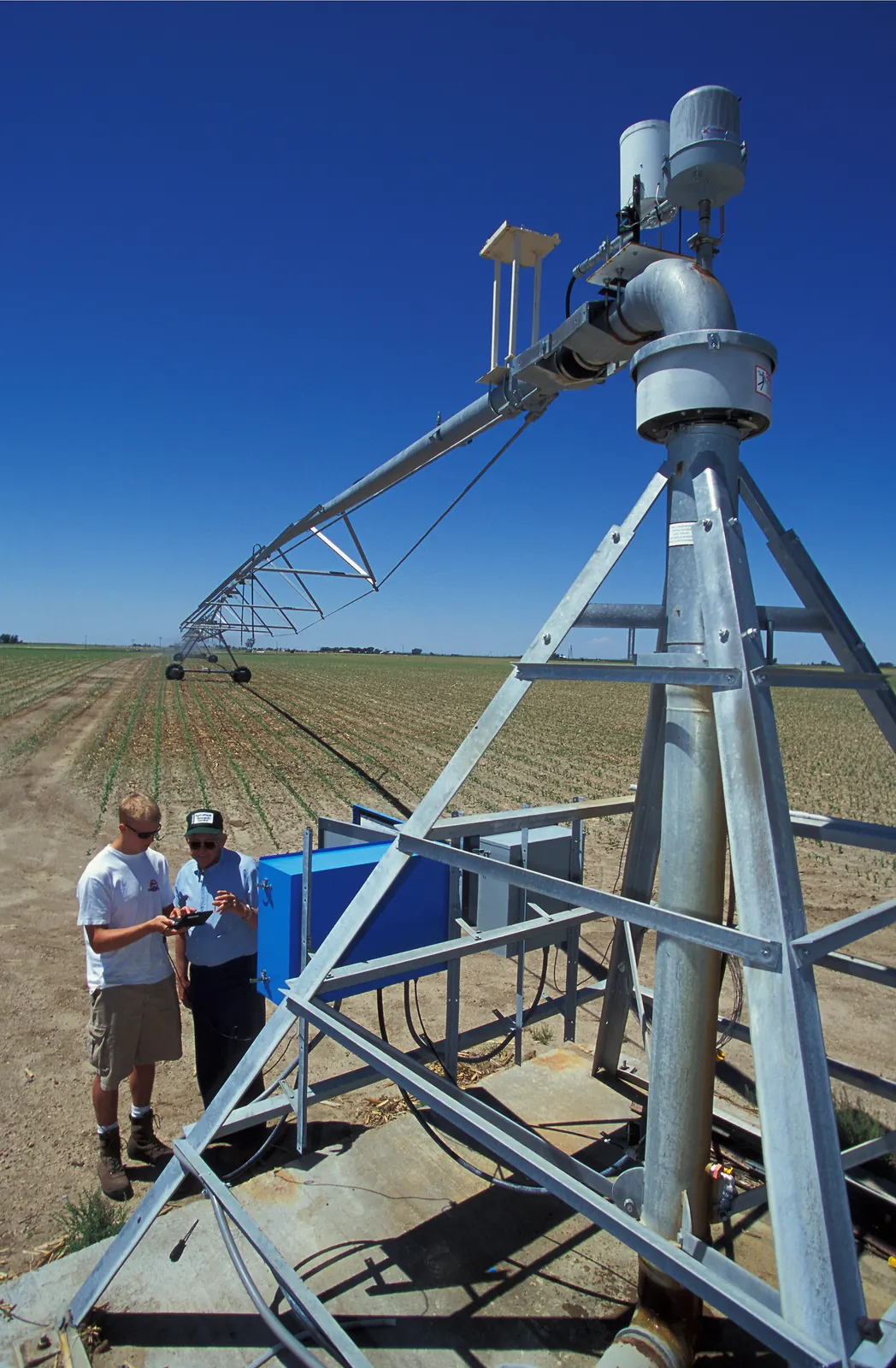
- Center pivot irrigation for large areas draws huge quantities in limited hours, and often requires very high-discharge wells.
- Traditional flood irrigation consumes much more water than the land's actual capacity and involves significant waste of fertilizers and effort.
- Your choice of irrigation system forms the basis for pipe sizing and the water pump from the start so we don't have to redo the work later.
How to calculate the required well flow for your farm step by step
The math isn't magic; it's simply a straightforward equation between the area, the amount of water the land drinks, and the operating hours you can run the pump every day.
- Multiply your land area in feddans by the daily requirement of a single feddan to know the total in cubic meters.
- Divide the total output by the available daily operating hours, whether on diesel or solar energy.
- The resulting figure is the hourly well flow that the drilling rig and pump need to deliver.
- If the result comes out too large and a single well in that area cannot handle it, we are forced to divide the farm into multiple wells or build an earth tank.
- This calculation protects you from digging an expensive well only to find out later it cannot cover half the area during severe heat.
How much water a feddan needs in a solar energy and submersible pump plan
When we tie water to solar energy, calculations get even more precise because the sun has limited actual working hours per day in which we must finish the entire water quantity.
- Proper design makes the panels run the pump at full capacity during peak sun to bring out the exact required quantity.
- We calculate the peak requirement of the feddan so the submersible pump doesn't stall on us in midday and ruin the crops.
- A pump of the right size lasts longer and draws correct amperes without burning out columns or bearing excessive loads.
- Integrating the well, pump, solar system, and irrigation under the management of a single engineer prevents shifting blame among contractors.
- We hand over the system ready to irrigate the area we agreed upon from the very first day of operation.
Frequently asked questions
Can we rely on neighboring well numbers to know how much a feddan needs?
Neighboring wells are a good indicative sign, but soil layers and water discharge vary even between adjacent plots of land.
What should I do if I discover the well flow is less than my land's requirement?
We sit down and study available solutions like installing a storage tank to collect well water all day and irrigate from it, or rehabilitating the well if it is clogged.
Does pipe type make a difference in delivering water to the land?
Of course, choosing the right diameter and pressure for UPVC or steel pipes prevents pressure loss and makes water reach the end line with the same strength.
Request a consultation and price quote from Aquavolt X
If you are still asking how much a feddan needs in your region and want someone to sit with you with pen and paper to calculate what's right from the start for drilling, pumping, solar, and irrigation, send us your land details and area via the price quote request form or WhatsApp, and a specialized engineer will contact you to prepare a preliminary study and a detailed price quote suited for your work.